





How to Choose a Designer Sofa
Article Overview:
- Understand what makes a sofa truly “designer”
- Measure both your room and the sofa’s delivery route carefully
- Look beyond just the upholstery when judging quality (frame, joinery, fillings)
- Prioritise durability, consider rub-count and care amount needed for specialist materials
- Consider how a sofa's overall shape affects the flow of the room and the furniture already there
- Choose the right configuration for your space, lifestyle and number of users
- See a designer sofa as a long-term investment or design family heirloom
- Try before you buy wherever possible to get a true feel for user satisfaction
Koji Sofa by Porada
Florence Knoll Sofa by Knoll
Your sofa has a lot asked of it. It is expected to host guests, endure film marathons, invite you for Sunday afternoon naps and provide a comfortable setting for late-night conversations. All while looking immaculate in the centre of the living room. No pressure, then.
After all, it is usually among the largest pieces in the home, one of the most frequently used and, whether it intends to or not, the first thing people notice when they enter the room. It's an investment as much as it is a very comfortable piece of design. More so than your own home at times. Often following whichever part of the planet you plant your roots.
So how do you make sure that your seating selection stays an evergreen purchase? Do you go monolith or modular? Minimalist or Maximalist? There are no wrong answers, of course, but more specifically, there are ways of picking the right one. Thus turning a seating solution into an instant family heirloom. Buying a piece that prioritises quality materials, moulded from decades of design experience and will hold (if not increase) value.
Are you sitting comfortably? Let's get into everything we know and think you should too about designer sofas.
Porada Abacus Seating Collection
Tufty-Time 20 Sofa by B&B Italia
Mon-Cloud Sofa by Cassina
What makes a sofa 'Designer'?
Luxury is often defined by labels. Fashion has Hermes, motoring has Rolls-Royce, and watches have Patek Philippe. But what separates those brands from the rest that makes them immediately synonymous with designer luxury? Their build quality and commitment to never needing another of the thing you're buying.
In the furniture world, this is no different. A designer sofa is defined by things like hardwood frames or hand-stitched upholstery, the details that would often get overlooked, plus the decades (or even centuries) of furniture history that have gone into a brand's process. It is that extra layer of luxury, a seat inexplicably more comfortable yet durable, a leather entirely devoid of imperfections yet more resistant than any other available.
See below one of our favourite examples, the Groundpiece by Flexform. Constructed from the finest materials, built with generations of knowledge and available to take nearly any shape you desire while carrying out multiple roles in the living room.
Groundpiece Sofa by Flexform
Groundpiece Sofa by Flexform
Groundpiece Sofa by Flexform
The trademarks of quality:
Judging quality would be much easier if every sofa arrived with its internal structure on display. Fortunately, most frames, springs and support systems (as technically brilliant as they are) get concealed beneath several layers of luxury upholstery and cushions. You therefore need to know what questions to ask. This is by no means the fun part of getting a new sofa. After all, nobody has ever invited friends over to admire a particularly impressive corner joint. However, it is the reason you'll get to keep inviting friends over for years to sit on the lounge setting they all love.
The frame is the element that holds it all together. This means the longevity is paramount. Ask about the quality of the wood, the joinery, and the bonding method; these are the big three for gauging the build quality of the sofa. We recommend a hard wood
The filling and suspension, feathers and foam are the near-universal choice when it comes to creating the comfort part of your new designer sofa. It is a mixture of the old ways and the new; the foam helps the sofa hold shape and envelop the user no matter who is sitting on it, whereas the feathers offer that pillowy comfort that you can sink into whenever required. The two together mean you don't need to spend time plumping cushions, but guests don't feel like they're waiting in the dentist's office.
The upholstery. The aesthetic marker for a quality sofa, let's face it, if you're reading this, you have some vested interest in the aesthetics of your space. Just as with fashion, tailoring is the ultimate status symbol.
When it comes to fabric, rub count is key; lounge furniture is high-use, so you'll want to know your chosen sofa upholstery has the resistance not to wear after years of scrolling through Netflix to find the film they inevitably don't have.
Leather is synonymous with luxury, and many of our brands go to incredible lengths to make sure it matches that expectation. The great thing about it is that it can be as soft as a cloud or as rigid as timber, meaning you can often have the entire piece upholstered with it. Keep in mind, it is a heavily porous material. It can be easily stained by liquids, and even extreme exposure to direct sunlight can change the pigment. So true high-end leather sofas come with a certain duty of care.
Optional Extras, including the use of fine materials like marble and glass or the execution of elements like reclining seats, adjustable headrests or internal storage, while maintaining quality synonymous with luxury.
Inland Sofa by &Tradition
Maralunga Sofa by Cassina
Emile Sofa by Molteni & C
Sizing up your sofa:
There is one particular part of buying a designer sofa that you have to do before all else, before deciding on the upholstery or getting emotionally attached to a particular design. That is making sure you know your limits. Literally. Measure the width and depth of the entire room. Then make sure you're considering the rest of the furniture that will accompany your new designer sofa (Side tables, lamps, etc.), and this will give you an excellent idea of the exact dimensions you need the piece to be.
Floor space isn't the only parameter you need to measure up before making that all-important purchase; you'll need to figure out whether your new piece can actually reach its intended location. Round corners, through doorways and up stairs, you want delivery to be as smooth as possible without it descending into some sort of Ross and Rachel style stairwell farce. Most living rooms exist in the immediacy of a space and are the first room that greets you. But still, make sure to map out its entire journey through your house and offer it up to whoever is managing logistics. For the benefit of both you and your delivery team.
Finally, it may seem pedantic, but don't forget to take into account the details of the piece itself and how they will contribute to the look and feel of the room. Low arms and raised legs can create a lighter visual footprint. Wide arms, deep cushions and a floor-level base will make the sofa feel more substantial, even when the overall dimensions are similar. One of the simplest ways to understand the scale is to mark out the sofa on the floor using low-tack tape. Do not stop at the main footprint. Mark the chaise, corner section or reclining elements in their fully extended positions. “It looked as though it would fit” is not especially comforting when several hundred kilograms of sofa are waiting outside.
Biboni Sofa by Knoll
DS-707 Sofa by De Sede
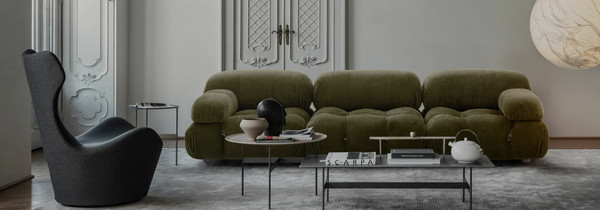
Camaleonda Sofa by B&B Italia
What configurations are available?
As big as they can be, sofas are a surprisingly versatile idea. They can twist and turn, detach and recline. All while being about as big or small as you desire. At the end of the day, the entire purpose of lounge seating is to make the living room the softest room in the house; the rest is completely flexible. After all, in the words of Jane Austen, "There is nothing like staying at home for real comfort".
We'll start with the traditional fixed sofa, perfect for small to mid-size rooms that already have a defined layout. A pre-designed space that just needs that finishing touch to the furniture ensemble. Its self-contained shape is easy to position and can be complemented with armchairs, footstools or occasional seating when more space is needed.
Corner sofas are the ultimate structural tool for a living room. Being that four walls are often the norm, having a piece of furniture designed to utilise at least two edges helps create a clear boundary for a lounging zone. Just as importantly, having such a large piece placed up against the walls guarantees you can maintain as much accessible floorspace as possible. Their ideal situation is big, wide open rooms that cater to high foot traffic.
Curved sofas are destined for the spotlight. Best deployed away from edges of a space, they often make up a central focal point of a room's DNA, afterall their gradual meandering form makes them nearly impossible to fit at the perimeter of a room, and why would you want to? Their sweeping forms can break up the straight architectural lines of a room, while their twists and turns encourage conversations between users, often placing them opposite each other.
Then there is the modular sofa. Offering one huge benefit that the aforementioned cannot. Flexibility. Made from individual seating elements, their recent rise to popularity (again) has seen the biggest names in design release re-issue after re-issue of retro-modular glory. They can be arranged as a straight sofa, an L-shape, a generous island or almost anything in between. Modules can often be added or rearranged over time, allowing the sofa to evolve alongside a growing family, a new home or a change in how the room is used.
Gogan Sofa by Moroso
Flaneur Sofa by Gubi
Bumper Sofa by Zanotta
Togo Sofa by Ligne Roset
Why to buy designer?
If we haven't accurately made our point yet, well .. give us one more chance. Most luxury items are items are for special occasions; they receive the attention they deserve on the rare day that an event calls for them. It could not be more different when it comes to designer furniture, especially modern sofas. Consistently in use day-to-day and constantly on display in the biggest possible way.
In short, here are a few of the standout benefits of investing in high-end design over a more cost-effective option:
- Build quality (Often from artisans with lifetimes of experience)
- Expert care and attention down to the finer details
- Owning a piece of furniture heritage and design history
- Wider range of customisation and personalisation
- Specialist materials only available to the biggest names
- Greatly increased use longevity and rub-count
- Household brands that are at the pinnacle of their industry
- Can carry shapes that are not always possible with standard manufacturing processes
Standard Sofa by Edra
Extrasoft Sofa by Living Divani
Craig Sofa by Cattelan Italia
Where to buy designer?
You can research through a screen to your heart's content, but if it's one thing we've learnt after 30+ years as one of the UK's foremost luxury furniture showrooms, you cannot make a more informed decision than the one you make in person. Because after all the measuring, all the swatches and switching tabs, you can only truly judge a sofa by its one true intended purpose: relaxing on it.
Your dream design may be just a little too shallow. Your laptop screen's colour profile might be making that vibrant fabric look washed out. It is one of the most intentional purchases you will make for your home, and one you will have forever to look at. So why not let the first time be in the presence of experts who can talk you through every step and every sample.
It's why we purposefully keep our space well-stocked with lounge settings from the biggest names in design so you can get an idea of the route our clients wish to go down.
Chaplins Showroom