












A Glowing Garden: A Guide to Outdoor Lighting
No part of your home receives light quite like the garden. The lack of a roof helps, of course — but what about the short time when the sun doesn’t shine? As much as some of us might wish the summer glow would last forever, even in the height of August the closest star to our planet still has to dip below the horizon for a while.
So what’s the answer — the one we’ve turned to for millennia? Lighting. Whether by lantern or floor lamp, the solution to the lack of light outside has always been simple: create more. It ensures the day doesn’t end when the sunlight does. And when the weather is warm, the last place you want to leave is outdoors.
Today, with so many options available at the flick of a switch or the turn of a dimmer, we thought we’d offer a little insight into illuminating a modern garden: what to use, where to place it, and which names are leading the way. Who knows — you might even find a few lightbulb moments of your own.
Gubi Outdoor Collection
Wall Lighting
We’re starting with a less obvious choice. When you think of the outdoors, walls aren’t the first thing that springs (pun intended) to mind. But, unfortunately, they have to begin and end somewhere.
From a more emotional perspective, they also mark the boundary of our escape from the outside world. So think of illuminating them as declaring the perimeter of your own personal paradise. For this particular purpose, it’s best to think more architectural than decorative (save the styling for your ambient lighting). Brands like Occhio and Vibia are ideal for softly defining the boundaries of your garden while enduring all weather conditions and constant use.
Pro tip: The absolute cornerstone of outdoor lighting is ensuring your doorways are well-lit. Think of it as a guiding light towards the gateway between interior and exterior.
Vibia Lighting Collection
Occhio Lighting Collection
Nuura Lighting Collection
Floor Lamps
Have you ever heard someone use the term “the big light”? Indoors, that usually means a pendant light. Step outside, however, and the phrase is almost completely inverted. The larger sources of light in our outdoor spaces often rise from the floor.
These tall, overhanging lamps create an anchor point of illumination — a place where guests can gather and conversation can continue long into the night. Take the Twiggy by Foscarini and position it arching over a dining table, and suddenly dinner al fresco can stretch as late as it might in the most relaxed corners of the Mediterranean.
Pro tip: Pair low seating with tall lighting. The contrast creates an almost palatial atmosphere without the need for surrounding architectural structure.
Gloster Lighting Collection
EMU Outdoor Collection
Foscarini Outdoor Collection
Table Lamps and Lanterns
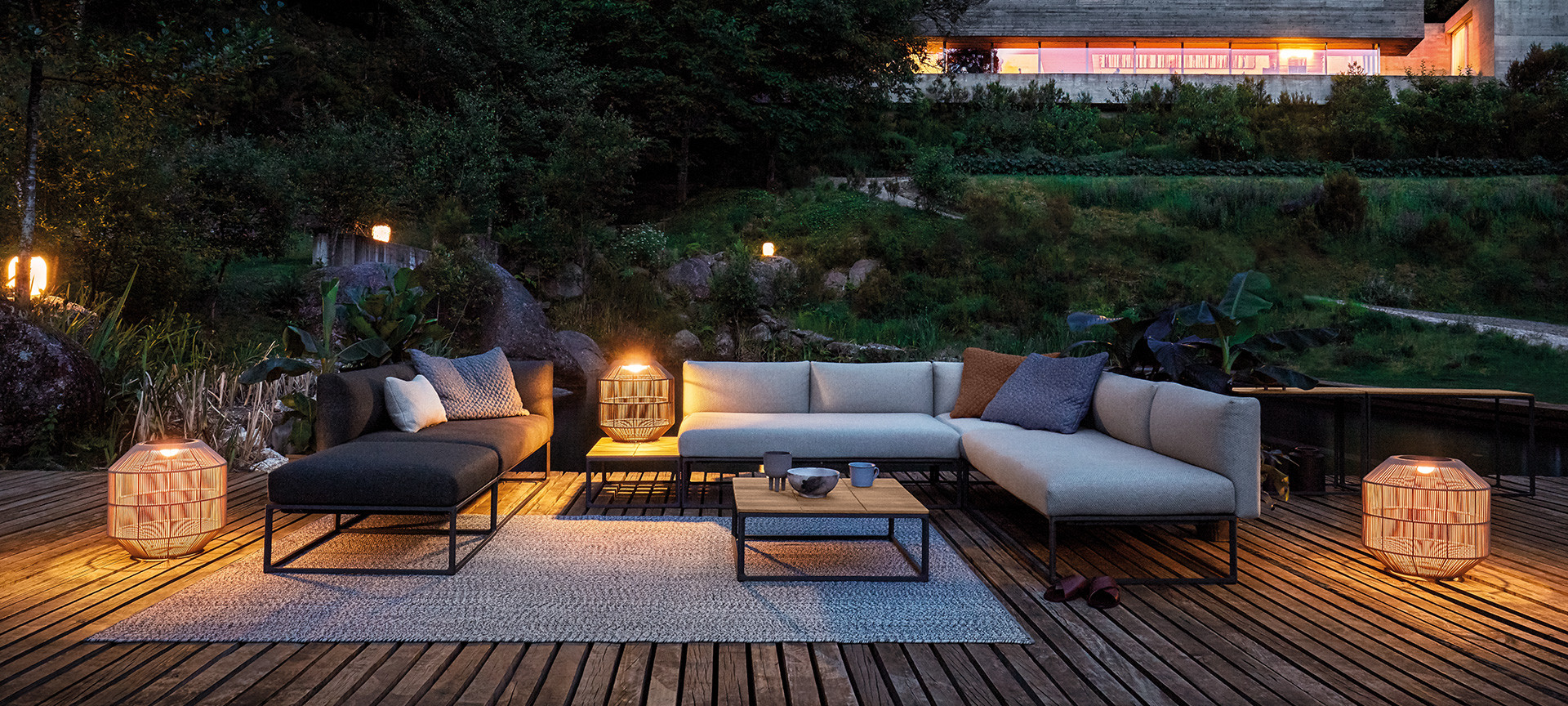
We’re going to look at two types of lighting here, both of which work in tandem and play similar roles in the orchestra of your garden’s glow: outdoor table lamps and lanterns. If wall lighting represents the more practical side of outdoor illumination, these are the free-flowing, atmosphere-creating elements that often go slightly unnoticed, yet provide the subtle glue that brings the whole space together.
Which of the two you choose is really a matter of preference. Outdoor table lamps offer a more practical solution, while lanterns bring a rustic charm that gently warms already balmy summer evenings.
Pro tip: When investing in an outdoor table lamp, look for solar-powered options. Not only are these typically designed for outdoor use, but they also save you the headache of heading outside only to realise the charger was switched on purely in your imagination.
Pablo Outdoor Collection
Contardi Outdoor Collection
Cane-Line Outdoor Collection
Bollard and path lighting
We return to a similar place to where we began: the practical side of lighting. After all, the highest purpose of light is to reveal a path through what you otherwise could not see. (We realise that sounds a little like a Gandalf quote, but our copywriter thought it was suitably dramatic.) The modern outdoor space is all about flow — providing pathways and direction not just for feet, but for the eye as well. Lighting is one of the most effective ways to achieve this. But when the sun goes down, and those carefully crafted walkways disappear from view, something else needs to guide the way.
Enter low, light-spreading ground lighting. In particular, bollards that play their own subtle game of dot-to-dot along driveways, paths and terraces alike.
Pro tip: Use this type of lighting sparingly and intelligently. Create paths with light — not with the lamps themselves.
Brokis Outdoor Collection
Vibia Outdoor Collection
Nemo Outdoor Collection
Lighting that isn't lighting?
It’s a sofa. It’s a light. Well — it’s both. Not quite Superman, but close enough. For our final — and probably our favourite — category in this guide, we arrive at designs that introduce lighting into your space while furnishing it in one elegant stroke.
Take Gloster’s Ambient parasol, which keeps you in the shade during the day and gently illuminates the garden once the sun sets. These are the true all-rounders of the outdoors, solving multiple needs with a single, thoughtful piece.
Pro tip: This type of lighting is particularly useful in smaller spaces. Multi-functional pieces allow you to illuminate and furnish an area without overcrowding it.
Gloster Outdoor Collection
Vondom Outdoor Collection
Foscarini Outdoor Collection