





In Conversation With: Michael Anastassiades
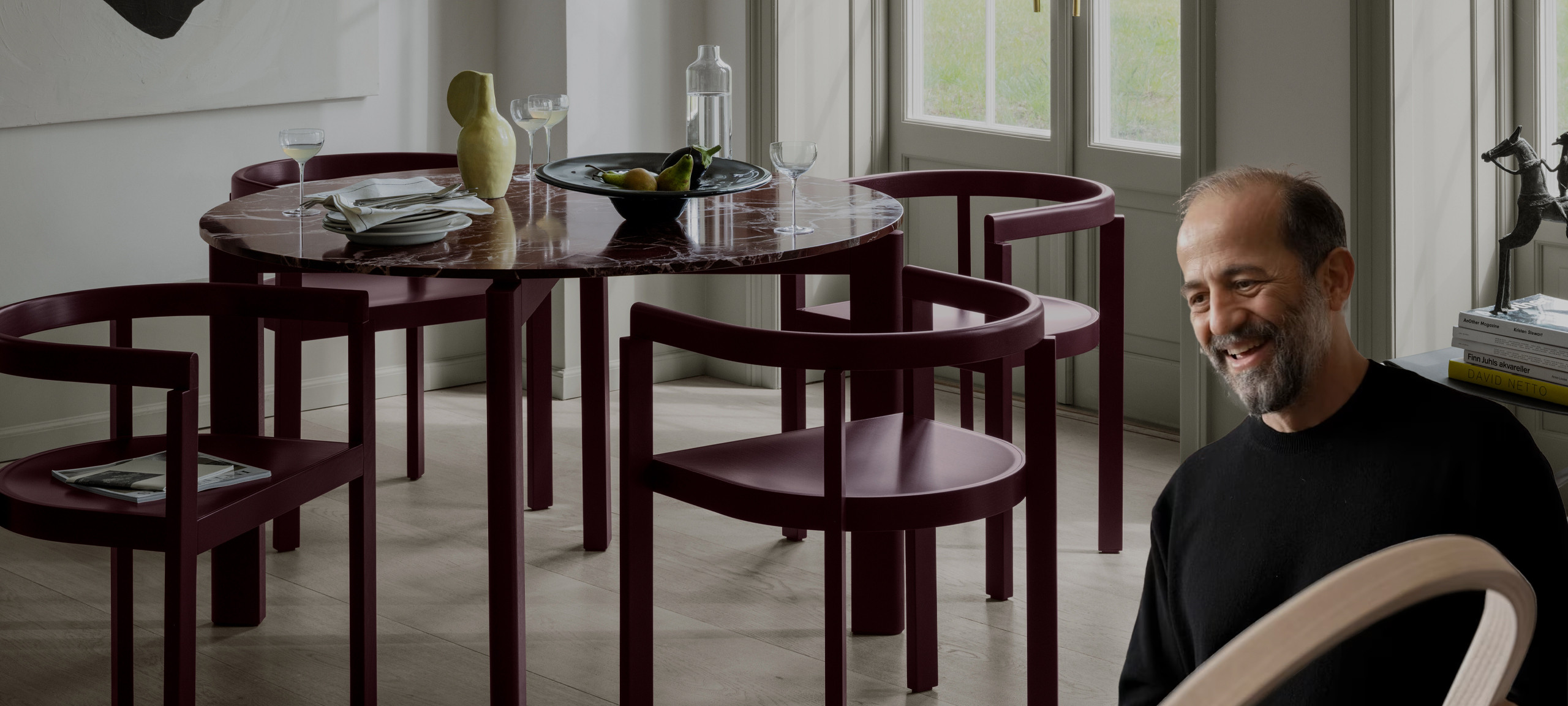
To celebrate our showroom launch of the After Series, our Head of PR, Ryan Smith, is sitting down with one of the most influential and creative minds to have dedicated himself to the world of design. A winner of awards, a shaper of light, and most importantly a man who champions his philosophies above all else. Michael Anastassiades has been at the forefront of contemporary interiors for, well, quite some time. Over the years, he has collaborated with manufacturers of equal stature, creating many of the pieces we’ve proudly displayed in our showrooms and dispatched to projects with stunning results.
So when we learned of the release of his latest collection - the After series - we wanted to do more than simply make it a showroom staple. We felt it was high time we got to know the designer whose work we’ve long admired and shared with furniture lovers. Join us on an intimate and inspiring journey with the Cypriot-born, London-based maestro, Michael Anastassiades, where we discuss all things past, present, and passion.
After Series by Michael Anastassiades - Fritz Hansen
After Series by Michael Anastassiades - Fritz Hansen
Hi Michael, how are you? I’m excited to talk to you. I’ve been in the industry for nearly ten years now, and I started just around the time you released Arrangements. You were one of the first names I came across, so this feels like quite a full-circle moment for me.
"I'm good, thank you, and that’s very kind of you!"
I wanted to start, well, at the start by asking you about founding your studio very early on and what that was like? When did you know you wanted to be a designer?
"It was about a year after I graduated from the Royal College of Art. At that point, I realised I wanted to pursue my own journey, figuring out what design meant to me.
I originally come from an engineering background, but when I graduated from Imperial College as a civil engineer, I knew I didn’t want to be an engineer any longer. So I spent two years studying design at the Royal College, at a masters level, which were wonderful, but even they still weren’t enough to give me a complete sense of direction. I had a lot of personal research to do before deciding what kind of designer I wanted to be. Even the graduation pieces that I came out with were not very conventional. I think I was pretty unemployable at that stage! But that helped me to start my own studio early in my career."
Michael Anastassiades - Fritz Hansen
Message Cup - Michael Anastassiades
So is that why you went into furniture design, to explore something more creative compared to engineering?
"Exactly. What I was developing back then was far from what was happening in the industry. My final project, for example, was an electronic product called the Message Cup. It was designed for people living in the same household to leave voice messages for each other.
At the time, the idea was way ahead of the curve—this was before text messaging was common. But of course, when I tried to get a job in a design studio with a concept like that, people looked at me quite strangely. I had no experience and only this conceptual project to show.
So I decided to set up my own studio as a platform to continue my personal exploration of design. My early projects gained some attention, mainly in academic and museum circles, but my audience wasn’t really the industry."
After Series Dining Chair by Michael Anastassiades - Fritz Hansen
After Series Dining Chair by Michael Anastassiades - Fritz Hansen
At Chaplins, we've been a part of London's design story for over 30 years, around about the same time as yourself, is there a romance or connection about the capital that keeps you here?
"London is constantly evolving. That’s what has kept me here since I arrived from Cyprus. Back then, there wasn't much in the way of universities in Cyprus, so if you wanted higher education, you had to go abroad. I had a British education, so it was natural for me to stay in the UK.
I chose London because I wanted to be at the centre of things, where opportunities and creativity were happening. After graduating, I realised I couldn’t go back—I needed to challenge myself and test my ideas in a big city like London. I couldn’t have achieved what I have if I hadn’t stayed here. London still excites me. No matter how many years pass, every year feels different."
That's very true about this city, I’ve lived here all 28 years of my life and I still find new places to explore, things to discover.
"Absolutely. Every area has its own culture, its own rhythm."
Speaking of Cyprus, has your heritage influenced your design choices or processes?
"Unfortunately not and fortunately not at the same time!
I didn’t grow up in a creative family. Nobody encouraged me to pursue design. My father probably never fully understood what I did, even though he knew I was successful. That lack of understanding actually motivated me, it made me work harder to prove myself. Leaving Cyprus also pushed me to survive and adapt. When you’re away from your comfort zone, you have to work harder."
After Series Dining Chair by Michael Anastassiades - Fritz Hansen
After Series Dining Chair by Michael Anastassiades - Fritz Hansen
I mentioned earlier your project Arrangements was a milestone for me personally—it was one of the first designs that made me fall in love with the industry. Do you remember a moment when you first realised design was your calling?
"Yes. When I was young, my father commissioned a modernist architect named Polyvios Michaelides to design our family’s country home. He had studied under Gio Ponti in Milan before World War II. Visiting his home left a huge impression on me—the furniture, the art, the architecture. It was my first exposure to true modern design."
When you begin a new project, what’s the very first step?
"It always starts with an idea from me. I never work from a strict brief. When I started my lighting brand, Michael Anastassiades, in 2007, I promised myself there would be no compromises. Later, when I began collaborating with brands like Flos, it was always under the condition that I decided what I wanted to create for them.
Before proposing anything, I study the company—its history, its DNA. I need to understand whether I have something meaningful to contribute. I’ve always believed design is a reflection of its time, so understanding that context is essential."
Arrangements Pendant Light by Michael Anastassiades - Flos
Arrangements Pendant Light by Michael Anastassiades - Flos
That's interesting, have you ever turned down collaborations because they didn’t align with that philosophy?
"Absolutely. If the conditions aren’t right, I don’t engage. I’m not interested in simply adding my name to a catalogue. I want my collaborations to be meaningful and long-term."
I suppose that brings us nicely to the After collection with Fritz Hansen (a brand we have worked with for nearly 30 years). It’s been wonderful to see your collaboration. How did that partnership begin?
"It started through a creative director I already knew. We shared a passion for design culture and history. After a few years of conversation, I met the CEO for dinner, and we began discussing possibilities. Shortly after, I developed the idea for After—and it just felt right for Fritz Hansen."
Where did the name for this particular collaboration name arise from?
"It reflects the idea that every piece of Scandinavian design references something that came before. Danish design is a collective evolution—each generation building on the last. Many Danish classics were influenced by traditional English furniture. So the name After recognises that lineage: every design exists after something else."
You’ve worked mostly with Italian and Mediterranean brands. Was this your first real venture into Scandinavian design?
"Not the first, but certainly a special one. I’ve always admired Scandinavian design. Interestingly, when I launched my brand Scandinavia was one of my strongest markets—particularly Sweden and Denmark. My aesthetic seemed to resonate there.
I’ve studied both Nordic and Italian design closely. They’re completely different worlds but equally rich in heritage and philosophy."
Design worlds collide - Lissoni Sofa by Piero Lissoni & Fritz Hansen
Design Worlds Collide - Carimate Dining Chair by Vico Magistretti & Fritz Hansen
A few light-hearted questions to finish. If you could share one meal around the After dining table, what would it be?
"Definitely home cooking. I love to cook—a mix of Cypriot, Greek, and Italian dishes, and a few English favourites I’ve grown fond of over the years."
Lovely. And if you were to open a store that didn’t sell furniture or lighting, what would it sell?
"Honestly, I think we already have too many things in the world. I’d rather have fewer, better things. So if I opened a store, it would still be about design—but perhaps more about curation and reflection than consumption."
After Series by Michael Anastassiades - Fritz Hansen
Beautifully said. Finally, is there one piece of design that makes your home feel like home?
"Yes, the PK12 chair by Poul Kjærholm. It’s a vintage piece I acquired from a gallery in Copenhagen. It’s not in production anymore, but it’s one of the most beautiful chairs ever made."
Wonderful choice. I was at 3 Days of Design this year and couldn’t get enough of the vintage galleries in Copenhagen—it’s like walking through a museum.
"Exactly. Every single piece tells a story."
PK12 Archival Imagery - Fritz Hansen
Series 7 Archival Imagery - Fritz Hansen
Those are all the questions I had written down and even a few that I didn't. Michael, it’s been an absolute pleasure speaking with you.
"Likewise. Thank you for the conversation."